 Alexander Köb
Modern cloud-native systems move fast. Kubernetes clusters scale automatically, workloads are deployed continuously, and infrastructure changes are pushed through pipelines multiple times a day.
But while delivery models have evolved, asset management in many enterprises has not.
For technical decision-makers, this creates a serious problem. You cannot manage what you cannot reliably see. And in volatile cloud environments, reliable visibility is much harder to achieve than most organizations expect.
If your organization runs critical workloads on Kubernetes, traditional asset management approaches are no longer enough. Static CMDBs, manually maintained diagrams, and spreadsheet-based mappings simply cannot keep up. What’s required is continuous, graph-based visibility into the actual runtime landscape — and that is precisely the gap CloudInspector is designed to close.
Volatility Breaks Traditional Asset Management
In classic on-premise environments, infrastructure components were long-lived and relatively stable. Servers, network segments, and virtual machines existed for months or years. Documentation could be updated periodically and still remain useful.
Kubernetes changes that equation entirely.
Pods are ephemeral by design. Services are redeployed frequently. Auto-scaling reshapes the runtime topology constantly. Infrastructure-as-Code modifies environments without direct human interaction. Dependencies are created and removed dynamically.
The result is a structural mismatch between how cloud-native systems behave and how asset management is often still organized. Documentation begins drifting from reality almost immediately. CMDB entries become snapshots of a past state rather than representations of the current system. Architecture diagrams are outdated shortly after they are created.
For decision-makers, this gap between perceived architecture and actual architecture introduces risk. Strategic planning, change governance, and compliance efforts rely on assumptions that may no longer be true.
The Business–Technology Disconnect
An equally critical issue is the missing link between business applications and technical components.
At the business level, organizations think in terms of capabilities: a customer portal, a payment platform, a regulatory reporting process. These capabilities generate revenue, ensure compliance, or differentiate the company in the market.
At the technical level, however, these capabilities are realized through a complex web of deployments, services, databases, APIs, and configuration objects. In many enterprises, the mapping between these two layers is incomplete, outdated, or scattered across different teams.
When a board member asks which systems support a revenue-critical service, the answer should not require days of internal investigation. When auditors ask which technical components are tied to a regulated process, the information should not depend on tribal knowledge.
Yet in many organizations, this traceability is created manually and maintained under constant pressure. It is fragile and difficult to keep current in dynamic environments. As a result, business decisions are made on partial visibility.
Dependencies: The Invisible Risk
Modern cloud-native architectures are highly interconnected. Services communicate internally and externally. Databases, message brokers, network policies, secrets, and configuration objects all form a dense web of relationships.
These dependencies are not always obvious. Some are implicit. Others only become visible at runtime. And because environments change so frequently, even well-understood relationships can evolve without centralized awareness.
This becomes particularly problematic during change initiatives. Whether upgrading a cluster, modifying a network policy, refactoring a service, or migrating infrastructure, leaders need to understand the potential impact before taking action.
Without reliable visibility into dependencies, impact analysis becomes an educated guess. In complex distributed systems, educated guesses can quickly turn into cascading failures, unexpected outages, or compliance violations.
The volatility of Kubernetes does not just increase operational speed; it amplifies the consequences of blind changes.
Why Static Documentation No Longer Works
Many enterprises attempt to manage this complexity through stricter documentation processes. They extend CMDB models, enforce additional reporting requirements, or conduct periodic architecture reviews.
While these efforts are well intentioned, they struggle against the fundamental nature of cloud-native systems. Manual documentation cannot scale with environments that change continuously. The faster the delivery cycle, the faster documentation drifts.
What is required is not more documentation effort, but a different structural approach. Asset management must be automated, continuously synchronized with the live environment, and capable of modeling relationships explicitly. It must also create a durable bridge between business context and technical reality.
This is where a graph-based model becomes essential.
A Knowledge Graph for Kubernetes
Cloud-native systems are inherently relational. Components depend on one another, communicate with one another, and influence one another. Representing them as isolated configuration entries does not reflect their true nature.
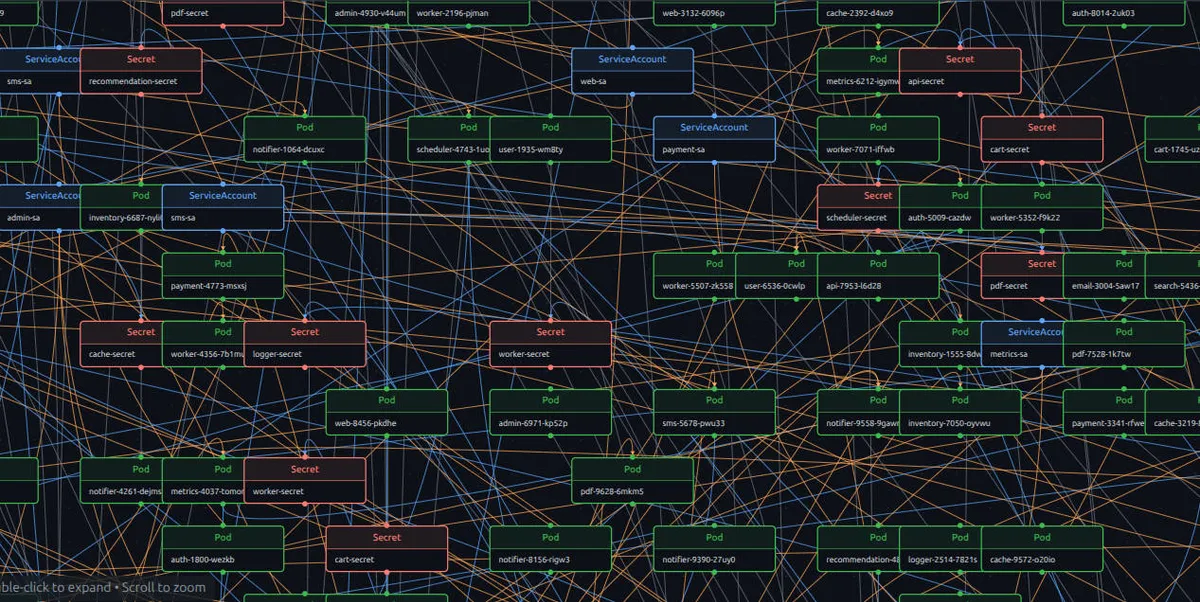
A knowledge graph models technical components as interconnected nodes and relationships as explicit edges. Instead of static diagrams, you gain a living representation of your environment. Dependencies are visible and queryable. Impact analysis becomes structured rather than speculative.
This approach transforms asset management from a passive documentation exercise into an active decision-support system.
CloudInspector applies exactly this model to Kubernetes environments.
How CloudInspector Restores Visibility
CloudInspector automatically derives a graph-based representation of your Kubernetes landscape directly from the live environment. Rather than relying on manual updates, it continuously reflects the current state of workloads, services, and infrastructure components, along with their actual runtime dependencies.
This creates architectural transparency that is both visual and analytical. Instead of piecing information together from multiple dashboards and configuration files, decision-makers and architects can explore their system as a connected whole. The blast radius of a potential change becomes visible before the change is executed.
Beyond real-time visibility, CloudInspector introduces a powerful time-travel capability. At any moment, you can inspect how your system looked in the past. For post-incident reviews, this is invaluable. Understanding what changed before an outage often determines how quickly root causes can be identified. For compliance and audit scenarios, being able to reconstruct historical states provides an additional layer of confidence.
Perhaps most importantly, CloudInspector enables the integration of business context through business labels. Technical components can be associated directly with business capabilities and applications. This creates a persistent, maintainable link between revenue-generating services and the infrastructure that supports them.
With this bridge in place, questions that once required cross-team coordination can be answered immediately. Leaders can assess how technical changes affect business-critical processes. Enterprise architects gain a consistent model that aligns strategy and execution. Governance becomes grounded in real system behavior rather than abstract diagrams.
A Strategic Advantage in Cloud-Native Environments
For technical decision-makers in mid-sized and large enterprises, the challenge is no longer simply operating Kubernetes reliably. It is maintaining control and transparency as complexity grows.
Cloud-native architectures are not becoming simpler. They are becoming more dynamic, more distributed, and more interconnected. In such an environment, reactive documentation and partial visibility create systemic risk.
CloudInspector replaces that uncertainty with continuous, structured insight. It reduces operational blind spots, strengthens impact analysis, accelerates root-cause investigations, and aligns technical reality with business priorities.
In modern cloud environments, clarity is not a luxury. It is a prerequisite for resilience and strategic agility.
If your organization depends on Kubernetes for business-critical workloads, the question is not whether you need better asset visibility. The question is how long you can afford to operate without it.
CloudInspector turns volatility into transparency — and transparency into control.
